Categories
Boosting Your Confidence Building Confidence Improving Your Presentations Public Speaking Goals Public Speaking Tips

Public Speaking Goals Restart

We are halfway through 2021 now. How are you doing with your 2021 personal and professional goals? What about your public speaking goals?
Could you use a mid-year goals restart? Time to check-in and see what you can still accomplish in the second half of the year!

I may not be a trend setter (yet), but I am absolutely a goal setter. I am very big into setting personal and professional goals, and I talk about this A LOT on The A-Ha! Method Podcast. Sometimes I am more talk than action though. 😞

I am constantly trying to improve myself, my routine, my skills, etc., which can be a blessing and a curse—blessing because I am all about self improvement, curse because it can become a bit like striving for perfection, which is an unattainable goal…even for me.

In the past few years, I have started making year-long mantras instead of goals. The mantras give me a simple, easy to remember phrase that I can repeat to myself when times are tough. My friend Susan, who I talk about in Podcast Episode 6, also makes yearly mantras with me, and we just so happened to have the same mantra this year—”I Am Here.”

We had different reasons for this mantra, but it’s still fun that we had the same one for the same year. My “I am Here” mantra has two meanings:

  1. I tend to have a lot of imposter syndrome, and 2021 has pushed me out of my comfort zone a good bit so far. The “I am Here” saying reminds me that I am supposed to be at this meeting, give this presentation, talk about this subject, etc. Whether I feel ready or not, I am here, and I am going to do the best I can.
  2. I have taken on the unfortunate habit of multi-tasking—both at work and in my personal life. I want to be more present in life with my family and friends and not be on my phone all the time. I am here, I am focused, I am listening!
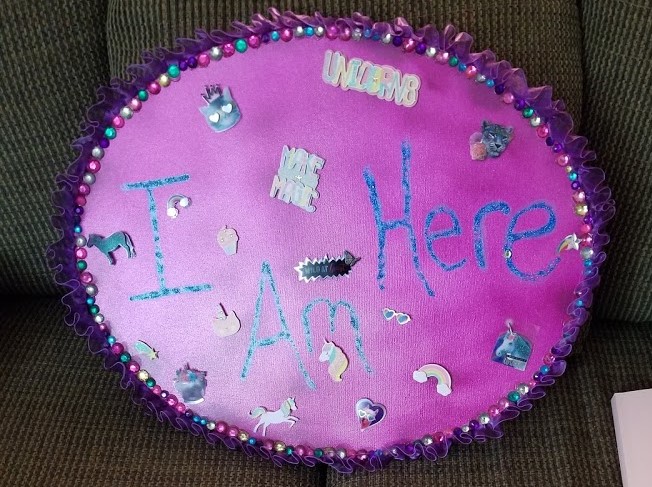
Picture of my 2021 Mantra Board that my friend Susan made me. Yes, we are in our 30’s and 40’s, and yes, I love every aspect of this special board!

So far, I have done okay with my 2021 mantra. I still want to be more present in everything I do, but that will take some time and more dedication. I have put myself out there more, and I am learning to be confident and continue to grow and learn from my mistakes. I will continue to work on this “I am Here” mantra, but now I also have some public speaking goals I want to add to the mix as well.


In the spirit of Quarter 3 just starting and us reaching the halfway mark in the year, I want to encourage you to sit down and review how you are doing with your goals so far. If things are going well, keep going and growing and glowing (this was my 2020 mantra)! If things could be improved, let’s do a mid-year goals restart and see if we can finish this year stronger physically and mentally than how we started. And if you don’t have any public speaking goals on your list yet, maybe it’s a good time to add some as well.

Here are my 3 public speaking goals/mantras for the second half of 2021 (I am putting it out on the internet, so no going back now!):  

  1. Quality over quantity
    • I have mentioned this on the A-Ha! Method Podcast and in other articles, but I really want this to be my big focus for the rest of this year. I want to work on crafting and developing my stories instead of just throwing out a bunch of stories and never telling them again. 
    • I set the goal to give 30 speeches this year, but I don’t have to give 30 different speeches. I would like to challenge myself by giving one speech topic five different times and truly experience the iterative and editing process. I’ll let you know how that goes. 
  1. Keep it simple
    • I have a tendency to overcomplicate things, like cramming lots of messages, takeaways, and lessons learned into a 5-7 minute Toastmasters speech and usually going over time.
    • In my sketches and improv classes, I tend to muddle the idea or forget the point of view to where you aren’t quite sure where it’s going or what I am trying to say. I want to be a better scene partner and writer and a simple way to do that is…keep it simple! 
    • I can get really wordy in my writing and also when I am facilitating meetings. Lots of run-on and long sentences back to back that really lose my audience. Keep it short, keep it simple! 
    • Keep it easy for my audience. Make sure my message and my meaning are easy to understand, and that will go a long way in my professional career and life!
  1. Embrace myself! 
    • This goes back to the imposter syndrome. I listen to some of my speeches and podcasts and think, “Why did I say that? Do I really sound like that? I really flubbed that sentence there.” I am definitely my own worst critic! I want to learn how to embrace myself—all the things I do well, all the mistakes I make, all my passions, all my quirks, all my silliness. Embrace it and stop wishing that I were someone else or as good as someone else, and just be me. 
    • I can keep striving to grow and fix some of these mistakes. However, if I can take the self-critic out of the situation, embrace myself, and be present, then I will take my speaking, my self-esteem, and my self-compassion to a new level. If I am constantly criticizing myself, I will forever limit myself!

I know all the SMART Goals advocates are pulling their hair out right now reading this. You have your way of making goals, and I have mine. These are my second half 2021 goals, and I am sticking to them! I will let you know how I fare at the end of the year!


There’s no magic time or age to wait to achieve your goals, and that includes public speaking goals. While I am using this half year mark as a chance to pause and reflect and also make more mantra goals for myself (all the mantras!), I want to remind you that you don’t have to wait until next week, next month, next birthday, next year to achieve your goals. You can challenge yourself now. You can go for your goals now! 

Want to conquer your fear of public speaking? Sign up for a course or training now! (Check out the A-Ha! Method: Public Speaking in a Time of Distraction course on Udemy.)

Want to give a big speech at work? Practice it now! (Come to one of our Speakers Alliance Public Speaking Practice Sessions.)

Want to give a Ted Talk? Can’t wait to hear it! Start working on your message now and practice it at our free sessions!

Want to step out of your comfort zone? Great! Get out of your own way and take one small step right NOW to start doing that.   

Cheers to the second half of 2021! Hope this mid-year goals restart helps you. Let’s check back in December 2021 and see how we did. 😀
Categories
Improving Your Presentations Podcast Professional Speaker Speaking at Conferences Speaking Hygiene

Episode 6: The A-Ha! Method Podcast

Speaking Hygiene

Most public speakers focus only on the time they’re up on stage, presenting. But the 24 hours before your speech are just as – if not more – important than the 20 minutes itself. Find out what you can do to keep your speaking hygiene 💯 and maximize your chances of getting invited back to speak again and again. 

Join hosts Dayna Gowan and Gabe Zichermann of the Speakers Alliance for another in-depth conversation about public speaking.

For more details and tips, check out our blog post about Speaking Hygiene.

Categories
Boosting Your Confidence Improving Your Presentations Podcast Public Speaking Tips Special Occasion Speeches Wedding Speeches

Episode 4: The A-Ha! Method Podcast

Social Speeches: How to Give the Best Toast of Your Life

Social speeches are often our first – and most important – moments for public speaking. Weddings, Bar Mitzvahs, funerals – they all require good speeches and often are what prompts us to improve our speaking in the first place. Join Gabe Zichermann and Dayna Gowan for an exciting episode in which we discuss the opportunities and pitfalls of the social speech, and how to master it on your first go around.

Categories
Improving Your Presentations Professional Speaker Public Speaking Tips Speaking at Conferences Speaking Hygiene

Speaking Hygiene – More than showering and looking good!

You’ve been preparing for this speech or pitch for weeks, maybe months. You’ve followed the lessons of the A-Ha! Method and developed a talk that’s going to get you that promotion, land you that funding, or raise your profile among your peers. The night before your talk you’re probably filled with excitement, nervousness and dread. You practice, practice, practice and go to sleep, ready for whatever comes tomorrow – the big day. 

Professional public speakers know something very critical: your “big day” actually starts the night before. The entire 18-24 hours before your talk, pitch or keynote requires special care and planning, in an effort we describe broadly as “speaking hygiene.”

No, speaking hygiene is not about showering and smelling good (though that’s also important and the subject of another article), but it is about ensuring that your time before the talk is carefully curated to ensure you’ve got the right energy level, the right focus, and the right amount of good stress. In short, you need to think like a rockstar, and put everything into the big moment. Here are some of the most important considerations:

Sleep

Make sure you know when your talk is, and ensure you’ve got enough sleep to maximize your alertness and calm. Time changes can wreak havoc on your body, so these must be factored in as well. If your talk is late in the day or you have an immovable scheduling issue, take a nap several hours beforehand. You’d be surprised how many major performers nap shortly before taking the stage – the key is to make sure your rhythms are in sync and you can do your best.

Eat

Eating is probably a major part of your day, and it can be tempting to just treat the day of your talk as any other day for food. But because too little food can leave you jittery and your stomach growling, and too much can leave you tired and sluggish, it’s crucial to time your meals appropriately. Eat well, but not too much and leave enough time to digest. Don’t eat anything heavy or carby right before, and definitely don’t walk out on stage with stuff stuck in your teeth (e.g. from a really recent bite). But do have something sweet nearby for after your talk: cognitively challenging activities deplete the energy in our brains and glucose is the cure. 

Caffeinate

Caffeine may or may not be part of your daily routine, but you’ll definitely be tempted to slam some back an hour or two before your talk as your energy flags and you worry about being at your best. Just as with food and water, make sure your caffeine intake is optimized for the talk you’re about to give. You want to make sure you don’t go overboard and end up jittery, or go under and laconic. If you want the caffeine to kick in right before your talk, plan to consume it approximately 20 minutes prior. Similarly, if you’re giving a really long talk, you might want to have some right before getting up on stage. Regardless, don’t overdo it. I’ve been there and it’s not cute. 

Investigate

I’m sure you think you know where to find the venue, your specific speaking location, and what time to be there. But don’t assume: it’s happened to me plenty of times where I get lost or the meeting point is non-specific, and I’m rushing to make it to my call time, out of breath and anxious. Whenever you can, do a walkthrough of the precise locations you need to be at and when. If you’re at an away event, you can do this the night before. If you’re somewhere local, do it the day of. Make sure you always leave yourself an additional 30 minutes to account for any hiccups, and don’t plan your flights or drives such that you’ll arrive right before your start time. Even celebrities build in contingencies. You should too. 

Isolate

You should do as little as possible before your talk begins. If your talk is first thing in the morning, you’ll have all day afterwards to socialize, network and the like. But if your talk is later in the day, you should focus on conserving energy for your performance. Wherever possible, don’t make significant intellectually-challenging plans for the time before your talk, and keep your socializing to a minimum. Again, think like a rockstar: the performance is the priority – and the point. Focus everything you’ve got on that one goal.

And therein lies the rub: the sooner you think of yourself as “performing” when you’re up on stage giving a talk, the better. Many speakers get caught in the loop of thinking they are Marketing Director first and speaker second, but on the day of a major and significant talk, embrace your inner diva. Prioritize your hygiene and watch your performance improve.

Categories
Fear of Public Speaking Improving Your Presentations Public Speaking Nerves Public Speaking Practice Special Occasion Speeches

A Toast to Social Speeches and How to Make Them Great

Weddings, Bachelor/Bachelorette Parties, Holiday Gatherings and Funerals are all situations in which we may find ourselves needing (or wanting) to give a speech. For many people, this is the first time they are prompted to improve their public speaking skills. For others, it is merely a nail-biting event at which we desperately want to succeed. 

Speaking professionals refer to these kinds of talks as “Social Speeches,” or Special Occasion Speeches, to differentiate them from business or political ones. The important distinction is in the name: speeches in this milieu are meant to evoke a particular kind of closeness or connection. Generally if you’re asked to speak at these events, the organizer will be less concerned with your polish and perfection, and more with your delivery of appropriately funny and/or touching anecdotes in a good spirited way. 

Whether this is the one and only time you’ll get up in front of people to speak, or just another step in your journey to become a better communicator, there are several key lessons you should observe when planning and executing a social speech.

Practice, Practice, Practice

Yes, social speeches are somewhat lower stress than professional keynotes. They are usually unpaid, often unsupervised, and – because the organizer is not usually an event professional – they are given minimal attention until the big day. Don’t let this lackadaisical and freewheeling environment fool you: to do a great job at public speaking – regardless of the context – you need to practice your heart out. If you use the approach described in the A-Ha! Method, you can save significant time and may find it easier to memorize and nail those points.

You Don’t Have to Be Funny

Film and TV tend to represent these social speeches as comedic moments. But if you don’t have the halcyon delivery of Owen Wilson or the hipster gravitas of Vince Vaughn, you may not be perfectly suited to hitting those jokes repeatedly. This is not to say that you couldn’t or shouldn’t be funny, but the suggestion is to know your voice and to embrace it. If you’re more serious, be more serious and heartfelt. If you’ve got a light touch, do that. Either way, you’ll be more successful if you embrace your own POV than trying to fit into someone else’s mold.

Shorter is Better

Most social speeches should be kept under 5 minutes. Just think about the typical wedding: if 6 people/groups need to speak, and each takes 10 minutes, you’ll be sitting there for a solid hour listening to family members and friends drone on. Take a cue from what you would enjoy and keep it to a nice tight 2-3 minutes. The shorter timeframe will help you focus and give you clarity. After all, it’s better to say one thing really well than 5 things poorly.

Grab The A-Ha! Moment

In every social speech there is typically one line: an anecdote, observation, expression of love or broader social issue, that is the memorable moment from the speaker. Much as we do when giving a keynote or conference talk using the A-Ha! Method, our process begins by thinking about those moments of connection with the audience, and then building a talk around it. This emotional high-point is the thing that will have the biggest impact, so it needs to be strong. In most social speeches, there is time for one A-Ha! Moment in the middle, and a strong tag at the end that wraps everything up and brings it together.

Strong Openings and Closings

There is a tendency for most speakers to “fill” time as the stage or mic is being transitioned to them. “Hi everyone, how’s it going?” is a great example, or mentioning the previous speaker(s) to then ease into your speech. It makes the speaker feel better, but increases the time from the switch over until your first point of brilliance is expressed. If you can, take a deep breath and launch directly into your speech without any transitional phrases. The same goes for the end: as you create the last line of the talk, make sure to clearly differentiate between the end of your talk and the start of a toast (for example). Toasts or blessings are not endings, and should be treated as separate from your core talk. 

Many professional speakers, when asked to talk about their most important talks, refer to these social speeches. You may spend your life on a keynote stage, traveling around the world – but perhaps the most important memories you’ll make will be much closer to home. So no matter where you are in your journey of improving your communications skills, now’s the right time to lean in. 

Here’s a toast to your upcoming social speeches – may you give them and give them well, and may you regale all your family and friends with your stories and talks at your next special occasion event. Cheers!

Picture credit: Canva.com